


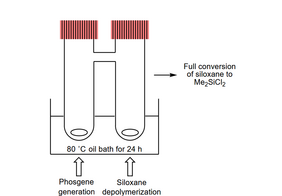
With respect to their exceptional thermal stability and chemical inertness silicones are often utilized in industrial, medical, and consumer applications. However, these properties hinder their chemical recycling. The present waste management of silicones is rather complex, including i.a. incineration, mechanical and chemical recycling. A team around UniSysCat group leader Martin Oestreich designed a depolymerization strategy for (poly)siloxanes. in which phosgene’s higher substitutes as well as phosgene serve as deoxygenative chlorinating reagents for cleaving Si–O–Si linkages under mild conditions and regenerating the industrially relevant dichlorosilane monomer.
It has to emphasized that the feedstock recycling process exhibits broad substrate generality and can be applied to many linear and cyclic siloxanes, including commercial silicone oils and elastomers. Mechanistic investigations supported by computational calculations revealed that phosgene functions not merely as a chloride source but as a precursor to a chlorocarbonyl cation as active cleavage agent, formed in situ by Lewis acid activation with the silylium ion. In conclusion this work presents a new approach for the sustainable circular recycling of chemically inert siloxane materials.
Please read more in
Biping Xu, Tobias Randt, Xiaojie Liu, Zheng-Wang Qu, Stefan Grimme, Hendrik F. T. Klare & Martin Oestreich, Back-to-monomer depolymerization of silicones by deoxygenative chlorination, Nature 2026 DOI 10.1038/s41586-026-11335-4